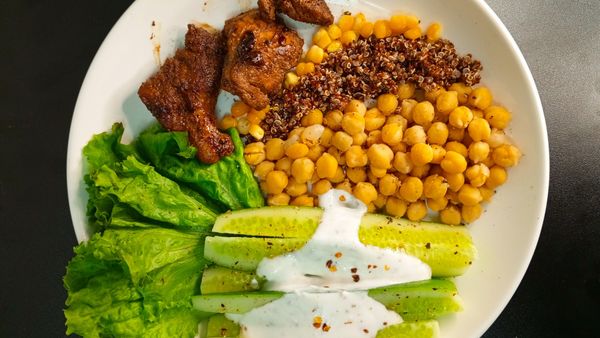
How Much Protein Do You Need Per Day?
The protein RDA is 0.8 g per kg of body weight, but active people and lifters often do better with 1.4 to 2.0 g/kg. Here is how to set and spread your intake.
Contents
Most healthy adults need at least 0.8 grams of protein per kilogram of body weight per day, which is the official Recommended Dietary Allowance (RDA). If you exercise regularly, and especially if you lift weights, research supports a higher range of about 1.4 to 2.0 g/kg per day. Around 1.6 g/kg is the point where extra protein stops adding much benefit for muscle gain in most people. Spreading that total over three or four meals works better than eating most of it at dinner.
The rest of this guide explains where those numbers come from, how to turn them into grams, how to split them across your day, and which foods make it easy. You can also plug your details into the protein calculator.
Why protein matters
Protein is made of smaller building blocks called amino acids. Your body uses them to build and repair tissue, including muscle, and to make enzymes and many other compounds it needs every day. Some amino acids can be made in the body. Others, called essential amino acids, have to come from food.
Your muscles are constantly being broken down and rebuilt. When you lift weights, you give your body a reason to build more than it breaks down, and eating enough protein supplies the raw material. That's the main reason active people are usually advised to eat more than the minimum.
The RDA is a minimum, not a target
The RDA of 0.8 g/kg comes from the U.S. National Academies' Dietary Reference Intakes. An RDA is the daily amount that meets the basic needs of nearly all healthy adults. For protein, that means it prevents deficiency and keeps the body's protein balance steady. It was never meant to be the ideal intake for someone who trains hard, wants to build muscle, or is trying to hold on to muscle while eating less.
In pounds, 0.8 g/kg works out to about 0.36 grams per pound. For someone who weighs 70 kg (154 lb), that's about 56 grams a day.
Higher targets for active people
The International Society of Sports Nutrition (ISSN) position stand on protein and exercise (Jäger et al., 2017) concludes that 1.4 to 2.0 g/kg per day is enough for most exercising people to build and maintain muscle. That's roughly 0.64 to 0.91 grams per pound.
A 2018 meta-analysis by Morton and colleagues pooled 49 trials of people doing resistance training. (A meta-analysis combines the results of many studies to get a clearer overall answer.) Gains in lean mass leveled off at around 1.6 g/kg per day. The authors noted that some people may benefit from going a bit higher, up to about 2.2 g/kg, which is why 1.6 is a sensible target and not a strict ceiling.
Here's how the main ranges compare, using a 70 kg (154 lb) adult as the example:
- RDA for healthy adults: 0.8 g per kg, or 0.36 g per lb. That's about 56 grams a day.
- Healthy adults 65 and older (PROT-AGE suggestion): 1.0–1.2 g per kg, or 0.45–0.55 g per lb. That's about 70–84 grams a day.
- Regular exercise or strength training: 1.4–2.0 g per kg, or 0.64–0.91 g per lb. That's about 98–140 grams a day.
- Practical target for building muscle: about 1.6 g per kg, or about 0.73 g per lb. That's about 112 grams a day.
Older adults are worth a separate mention. An expert group (the PROT-AGE study group, Bauer et al., 2013) suggested 1.0 to 1.2 g/kg for healthy people over 65, because muscle tends to respond less to protein with age. If you're older and also lift weights, aiming toward the active range is reasonable. Check with your doctor first if you have any health conditions.
How to calculate your own number
- Find your weight in kilograms. Divide pounds by 2.2046. A 180 lb person weighs about 82 kg.
- Pick a multiplier. Use 0.8 if you're mostly sedentary and just want the minimum, about 1.2 if you're moderately active, and 1.6 if you lift weights or train hard several times a week.
- Multiply. 82 kg × 1.6 = about 131 grams a day.
- Divide by your meals. 131 grams over four meals is about 33 grams per meal.
- Round sensibly. A target of "about 130 grams" is more useful than 131.2.
If you carry a lot of body fat, using total body weight can give a number that's higher than you need. In that case, base the math on a reasonable goal weight instead.
Spreading protein across the day
How you split your protein matters less than your daily total, but distribution still helps. Muscle protein synthesis is the process your body uses to build new muscle tissue, and research suggests that each meal should contain enough protein to switch it on fully. Eating a small amount at breakfast and a huge portion at dinner gives you fewer of those chances during the day.
In a 2018 paper in the Journal of the International Society of Sports Nutrition, Schoenfeld and Aragon suggested aiming for about 0.4 g/kg per meal across at least four meals to reach about 1.6 g/kg a day. The ISSN position stand gives a similar per-meal range of about 0.25 to 0.4 g/kg, or roughly 20 to 40 grams for most adults, spaced every three to four hours.
For a 70 kg adult, 0.3 to 0.4 g/kg works out to about 21 to 28 grams per meal. A practical pattern:
- Breakfast: eggs with Greek yogurt, or tofu scramble with toast
- Lunch: a palm-sized or larger serving of chicken, fish, tofu, or beans
- Afternoon: cottage cheese, milk, edamame, or a tuna sandwich
- Dinner: another full protein serving with vegetables and a carbohydrate
Many people eat a light breakfast and a big dinner. Moving some protein earlier in the day is often the easiest fix.
Protein in common foods
The amounts below are rounded estimates for typical servings, based on USDA FoodData Central values. Brands and cooking methods vary, so check the nutrition label when you have one.
Animal foods:
- Chicken breast, cooked, skinless: about 26 g in 3 oz (85 g)
- Salmon, cooked: about 22 g in 3 oz (85 g)
- Lean ground beef (90%), cooked: about 22 g in 3 oz (85 g)
- Tuna, canned in water, drained: about 20 g in 3 oz (85 g)
- Greek yogurt, plain, nonfat: about 17 g in 6 oz (170 g)
- Cottage cheese, low fat: about 12 g in 1/2 cup (113 g)
- Milk (cow's): about 8 g in 1 cup (240 ml)
- Egg: about 6 g in 1 large egg
Plant foods:
- Firm tofu: 12–20 g in 1/2 cup (about 125 g), depending on the brand
- Lentils, cooked: about 9 g in 1/2 cup
- Edamame, shelled, cooked: about 9 g in 1/2 cup
- Quinoa, cooked: about 8 g in 1 cup
- Black beans, cooked: 7–8 g in 1/2 cup
- Peanut butter: about 7 g in 2 tbsp
- Almonds: about 6 g in 1 oz (about 23 nuts)
Looking at these numbers side by side shows why a 3 oz serving of meat or fish makes reaching 20 to 40 grams in one meal fairly simple, while plant foods often need to be combined. Plant-based eaters can reach the same targets, though it usually takes larger portions or more variety. Mixing sources like soy, lentils, beans, grains, and nuts across the day gives you a good spread of amino acids.
Do you need to worry about eating too much?
For healthy adults, the ISSN reviewed the evidence and reported that intakes in the 1.4 to 2.0 g/kg range haven't been shown to harm kidney function or bone health. Even so, a few points are worth keeping in mind:
- Kidney disease is the big exception. If you have chronic kidney disease or reduced kidney function, you may be told to limit protein. Don't raise your intake without talking to your doctor or a renal dietitian first.
- Other conditions matter too. If you have liver disease, a metabolic disorder, or diabetes, or you're pregnant or breastfeeding, ask a health professional what's right for you.
- Protein doesn't replace the rest of your diet. Very high protein intake can crowd out fiber-rich foods like vegetables, fruit, whole grains, and legumes.
- Food safety still applies. Cook meat, fish, and eggs properly and store leftovers safely.
Putting it together
Setting your protein target comes down to a few simple steps. Work out your weight in kilograms, pick a multiplier that matches your activity (0.8, about 1.2, or about 1.6), and set a daily target in grams, rounded to the nearest 5 or 10. Then plan 20–40 grams of protein at three or four meals so you aren't trying to catch up at dinner. If you have kidney disease or another relevant condition, check with a doctor before making changes.
Protein works best alongside enough total food and regular training. If you aren't sure how much you should be eating overall, start with how to calculate your maintenance calories, and if you want a simple lifting routine to go with it, see the beginner strength training plan.
Sources
- International Society of Sports Nutrition, position stand on protein and exercise (2017)
- Morton et al., protein and resistance training meta-analysis (2018)
- National Academies, Dietary Reference Intakes for protein
This guide is general information for healthy adults, not medical advice. If you have a health condition, are pregnant or have pain, talk to a doctor or other qualified professional first. See the health disclaimer.