How to Find Your Rising Sign and Why Birth Time Matters
How to find your rising sign, why your exact birth time matters, where to track it down, what to do if it's unknown, and morning habits for all 12 risings.

Contents
If you've ever read about your Sun sign and thought, "That's not quite me," your rising sign might fill in the missing piece. Also called the Ascendant, it's the zodiac sign that was rising over the eastern horizon at the exact moment you were born. Astrologers often link it to your outward style, your first impressions, and how you approach anything new, including each new day.
The catch is that finding it requires something many people don't have on hand: an accurate birth time. This guide explains why that time matters, where to look for it, what to do if you can't find it, and how each of the twelve rising signs might shape a morning routine.
Why the rising sign depends on your birth time
Over the course of a day, Earth rotates once, and all twelve zodiac signs appear to rise over the eastern horizon in turn. That means a new rising sign comes up roughly every two hours on average. The exact span varies: depending on your latitude and the time of year, some signs rise in well under an hour and others take three hours or more.
Your Sun sign changes about once a month, so a birth date alone settles it in most cases. The rising sign is far more sensitive. Here's roughly how much an error in birth time can affect your chart:
| If your recorded time is off by... | Rising sign | House placements |
|---|---|---|
| A few minutes | Usually unchanged, unless you were born near a sign change | Rarely affected, except for planets close to a house line |
| About 30 minutes | Could change, especially if born near a cusp | Some planets may shift houses |
| One to two hours | Has a real chance of being a different sign | Several planets may shift houses |
| Unknown entirely | Can't be determined with confidence | Not reliable |
The rising sign also sets the starting point of the first house, so it anchors the whole house structure of your chart. Get the time wrong and the entire wheel rotates.
Where to find your birth time
Before guessing, it's worth some detective work. These are the most common sources, roughly from most to least reliable.
| Source | What to know |
|---|---|
| Long-form birth certificate | Some states and countries record the time of birth on the full or "long-form" version, while short-form certificates often leave it off. In the US, you can usually request one from the vital records office of the state where you were born. |
| Hospital or medical records | The hospital may have a delivery record, though retention policies vary and older records may no longer exist. Contact the hospital's medical records department. |
| Baby book or birth announcement | Parents often wrote down the time. Check family keepsakes, old cards, or newspaper announcements. |
| Family members | A parent or relative who was present may remember. Ask for specifics ("Was it before or after breakfast?") to narrow it down. |
| Religious or community records | Some baptism or naming records note details of the birth, though this is less common. |
A few tips while you search:
- Times are often rounded. A recorded 3:00 p.m. could mean anywhere from 2:50 to 3:10. If you were born close to a sign change, keep that in mind.
- Confirm the time zone. Chart calculators handle daylight saving time automatically, but double-check that you entered the correct birthplace.
- Family memory is a starting point, not a final answer. "Early morning" is useful, but treat it as a range.
What to do if your birth time is unknown
Not finding a time is common, and you can still use astrology for reflection. Here are your options.
- Work with a time range. If you know you were born "between 6 and 8 a.m.," run charts for both ends of the range. If the rising sign is the same in both, you can be fairly confident.
- Focus on what doesn't need a time. Your Sun sign, the signs of Mercury through Pluto, and most aspects are stable across a single day. Your Moon sign usually is too, unless the Moon changed signs on your birthday.
- Use a noon chart. Many astrologers set an unknown time to 12:00 p.m. Since the Moon travels about 12 to 15 degrees a day, a noon chart keeps its position within roughly seven degrees of the true one, but ignore the rising sign and houses it produces.
- Try a solar chart. This places your Sun sign on the first house, giving you a house framework for reflection without claiming to show your true Ascendant.
- Consider rectification. Some professional astrologers offer "rectification," estimating a birth time by comparing life events with the chart. Results are interpretive, so treat any rectified time as a working hypothesis.
- Observe and reflect. Read descriptions of the rising signs possible in your time range and notice which feels familiar. Use that as a tentative label and stay open to revising it.
How to find your rising sign: step by step
- Gather your birth date, the most precise birth time you have, and your birth city.
- Enter them into a reputable birth chart calculator.
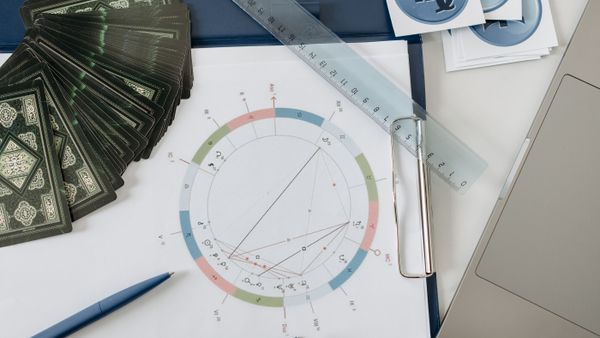
- Find the line labeled "Ascendant" or "ASC." On a chart wheel, it's the horizontal line on the left side, at about the nine o'clock position.
- Note the sign and degree (for example, "Libra 14°").
- If the degree is very early (0–2°) or very late (28–29°), you were born near a sign change. Hold the result loosely unless your time is precise to the minute.
- Read about your rising sign and compare it with your experience. Our sign guides are a good place to start.
The 12 rising signs and your morning routine
Because the rising sign is often tied to how you approach beginnings, the morning is a natural place to put it to work. Here's a short, routine-focused description of each one. Read your rising sign's entry first, then your Sun sign's, and see which feels closer to how you actually start your day.
Aries rising
You may like to start fast and feel momentum early. A quick physical action, like a set of push-ups or a brisk walk, can set the tone. Keep the morning list short so the energy goes into doing rather than planning.
Taurus rising
A slow, sensory start often suits you. A consistent breakfast, a favorite mug, or a few minutes outside can help you ease in. Try waking 15 minutes earlier so the morning never feels rushed.
Gemini rising
Your mind may wake up before your body. A podcast, a few pages of reading, or a short journal entry can channel that curiosity. Rotate your morning activity weekly to keep it fresh.
Cancer rising
You may feel more ready for the world after some time in your own space. A cozy ritual at home, like making tea or watering plants, can provide that buffer before the day's demands.
Leo rising
Starting the day feeling put-together may matter to you. Choose an outfit the night before, play music you love, and start with a task that lets you feel proud early on.
Virgo rising
Order may help you feel calm. A five-minute tidy, a written plan, or a short checklist can clear mental clutter. Just keep the list realistic so it supports you rather than judges you.
Libra rising
Harmony and beauty may help you get going. A pleasant playlist, open curtains, or a tidy, attractive space can make mornings easier. If decisions slow you down, settle breakfast and clothes the night before.
Scorpio rising
You may prefer a private, focused start. Protect the first 20 minutes from notifications, and use them for something meaningful to you, like reflection, a workout, or deep reading.
Sagittarius rising
Movement and a sense of possibility may motivate you. A walk on a new route, a few minutes reading about something you want to learn, or an outdoor coffee can widen your outlook before the day narrows it.
Capricorn rising
A structured, purposeful start often feels right. Review your top priority, check your calendar, and begin with a task that moves a longer-term goal forward, even by a step.
Aquarius rising
You may resist rigid routines but enjoy a smart system. Experiment with a "morning menu" of three options and pick one each day, or try an unconventional habit that genuinely interests you.
Pisces rising
A gentle, imaginative transition from sleep may help. Soft light, quiet music, or a few minutes of writing down dreams or thoughts can ease you into the day before screens take over.
For more element-based ideas, see our morning routines by element, and if your rising sign suggests you like to move early, our zodiac workout guide offers activity ideas by sign.
Quick checklist: finding and using your rising sign
Key takeaways
- Your rising sign is the sign on the eastern horizon at your birth, and it changes about every two hours on average.
- An accurate birth time matters because it determines both your rising sign and your house placements.
- Look for your time on a long-form birth certificate, in hospital records, in family keepsakes, or by asking relatives.
- If your time is unknown, work with a range, focus on time-independent placements, or use a noon or solar chart for reflection.
- The rising sign pairs naturally with your morning routine; let it inspire small habits, then keep what works for you.
Once you've found your rising sign, check today's routine and notice how it lands alongside your morning style.
This article is for general information and entertainment. It is not medical, psychological or professional advice. See our disclaimer.